
The One-Page Document To End Repeating Debates
Stop reiterating. Start deciding. A practical guide to Architecture Decision Records.

The most expensive meetings are the ones where you repeat the same topics all over again. You walk out of a heated discussion about a technical approach—database choice, service boundary, caching strategy—without writing down the positions, the trade-offs, or even what you decided. Two weeks later, someone raises the same question. Same arguments. Same people. Same inconclusive ending. Not because the team is bad at decisions, but because decisions without artifacts aren’t really decisions. They’re conversations that dissolved into a void.
Remote and async work makes this worse. Decisions happen in meetings half the team misses, or in Slack threads that scroll into oblivion. The pain isn’t about “we need more documentation”. The pain is wasted time, unclear ownership, and a team that can’t move forward because no one’s sure what was already agreed.
Architecture Decision Records (ADRs) fixed this for my projects. Not as documentation overhead, but as a structured approach to conversations we were already having in an unstructured way.
The Real Cost of Undocumented Decisions
Decisions made in Slack threads or meetings leave no artifact. No traceability. Someone asks “how do we plan to fix this?” or “why did we choose X?” and the answer becomes an archaeological dig through chat history, meeting recordings, or the memory of whoever happened to be in the room.
Without a clear decision record, anyone can reopen the debate. And they will. Not out of ill intent. They genuinely don’t know it was already settled, or they weren’t there when it happened. Management can’t track blockers when decisions are stuck in someone’s head. Work stalls quietly.
In startups, the response is often “we’re too small for process”, which is ironic. You’re already paying the cost: repeated debates, context that lives in one person’s brain, in onboarding that requires a verbal history lesson. Not documenting decisions is a shortcut, and like every shortcut, it’s a bet. You’re betting you won’t need to revisit them. I’ve seen it firsthand: in some of my previous teams there was no single source of truth for architectural decisions. Every onboarding became a tribal knowledge transfer. A good number of refactor proposals started with “check the code” commonly followed by “why did we build it this way?”
At scaleups, the coordination overhead multiplies. Fifty engineers means fifty people who might reasonably ask “why?”. Without a record, that could mean fifty separate conversations to answer them.
What ADRs Actually Are (And Aren’t)
An Architecture Decision Record (ADR) is, at its core, a record of why a decision was made, not just what was decided. That distinction matters. The “what” is usually visible in the code. The “why” disappears the moment the meeting ends.
Think of ADRs as requirements engineering disguised as documentation. The artifact, the written record, is a byproduct. The real value is the structured decision-making process that produces it. Writing an ADR forces you to articulate the problem before jumping to solutions. Why before what principle.
ADRs can be a tool for async decision-making in remote teams. They’re the reference that ends “why did we...” conversations in thirty seconds. They are not bureaucratic overhead—a useful ADR can be a ten-line markdown file in your repo. They’re not only for “big” decisions; anything worth debating twice is worth an ADR. And they don’t replace discussion, they structure it.
The Minimum Viable ADR needs just four fields:
Context: What’s the situation? What problem are we solving?
Decision: What did we decide?
Consequences: What are the trade-offs? What did we accept or reject?
Status: Draft / Proposed / Accepted / Superseded
A more extended version adds:
Positions: All approaches considered before the decision was taken. Typically two to four options, each with pros and cons, with the decision stating which approach won (or a combination, if the approaches were complementary).
Stakeholders: Who needs to be consulted or informed? Who has the final call?
Related ADRs: Links to previous decisions this one builds on or supersedes.
Date: When the decision was proposed and when it was accepted.
Artifacts: Freestyle :) Various proofs or even raw data related to positions and the final decision.
ADRs can live anywhere: a markdown file in your repo, a Confluence page with tags and mentions, a Notion database. The format matters far less than the habit.
As AI-powered search becomes standard, structured records like ADRs become even more valuable. They’re exactly the kind of knowledge that LLMs and search tools can surface instantly.
How ADRs Changed Dynamics Inside My Team
At one of my teams, I introduced a full Architecture Repository. ADRs were one piece alongside Architecture Migrations, Procedures, Post Mortems and a Risk Registry. But ADRs had the most immediate impact.
Before ADRs, the same debates resurfaced every few weeks. Decisions stalled because no one knew who owned them. Remote team members felt excluded from decisions made in meetings they couldn’t attend. Management couldn’t see what was blocked or why.
After we adopted ADRs, these things changed:
Fewer “why did we do this?” conversations. New project members (e.g. engineers or project owners from different teams) onboarded faster. They read the ADRs instead of hunting down so-called tribal knowledge. We use ADR references instead of re-explaining context in every PR and discussion thread.
Clearer blockers. “We need a decision on ADR-XYZ-042” became a trackable, actionable item. Management got more responsive when decisions were formalized. It’s harder to ignore an official ADR than a chat thread buried under emoji reactions.
Async work, unlocked. Remote-first teams could propose, debate, and decide without synchronous meetings. Comments on the ADR replaced circular threads that went nowhere.
Faster decision velocity. Structured options forced focus. Instead of endless open-ended debate, we evaluated concrete trade-offs side by side. Decisions that used to take weeks took days.
(the unexpected benefit) Mental clarity. Writing an ADR forces you to clarify your own thinking. You take all the feedback, all the competing concerns, and put them into structured form. More than once I heard engineers say some version of: “I thought I knew what I wanted until I tried to write down why.” The act of writing is the act of thinking.
Notice these benefits cut across all four layers of value: faster decisions help the company, async unlocking helps the team, clearer blockers help customers get features sooner, and the mental clarity is deeply personal. ADRs might feel like overhead, but the decision is the deliverable. Shipping the ADR is shipping value, not activity.
The 5-Minute ADR Test
Not every decision needs an ADR. But more decisions deserve one than most teams think. Here’s a quick test: ask these five questions. If you answer “yes” to two or more, write an ADR.
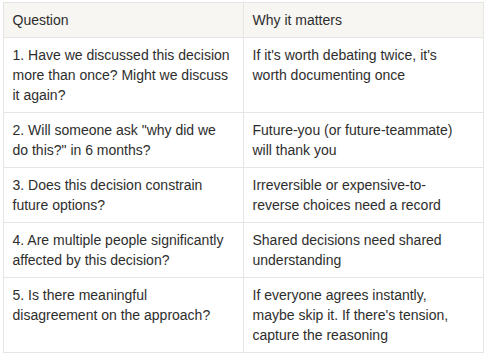
Try this: Think about the last three technical debates your team had. Run them through this test. I’d bet at least one deserved an ADR.
ADR Lifecycle: From Draft to Superseded
ADRs aren’t static documents. They move through stages:
Draft. You’re still forming the proposal. Not ready for formal review, but visible to the team.
Proposed. Ready for team input. This is where async discussion happens—comments, counter-proposals, refinements.
Accepted. Decision made. This is now the canonical record. The team aligns on this.
Superseded. A newer ADR replaces this one. Link to the new ADR so the decision trail stays clear.
Deprecated. No longer relevant. The system was removed, the context changed, the decision no longer applies.
The key rule: ADRs are append-only. You don’t edit an accepted ADR. You supersede it with a new one that references the old. This preserves the full decision trail, including why you changed course.
One process tip that makes the whole system work: assign a clear owner to every ADR. Someone needs to shepherd it from Proposed to Accepted, gather input, and make the call or escalate if needed. Ownership applies here just as much as it does in code.
Maintaining Your ADR Repository
ADRs only work if people can find them. The fastest way to kill adoption is a repo of decisions nobody can navigate.
Discoverability is everything. Use consistent naming: ADR-XYZ-001, ADR-XYZ-002 or a tagging system. A simple index file that lists all ADRs with their status and a one-line summary goes a long way.
Link ADRs to code. Reference them in comments, commit messages, and PR descriptions. “See ADR-017 for context” turns a confusing code decision into an understandable one. Consider making ADRs part of your acceptance criteria or definition of done for decisions that affect architecture.
Review quarterly. Are there Proposed ADRs stuck in limbo? Superseded ADRs that need cleanup? A thirty-minute quarterly review keeps the repository healthy and signals that the team takes decisions seriously. Think of it as keeping your decision-making process evolving alongside your codebase.
Keep ADRs close to the work. Markdown files in /docs/adr/ in the code repo get seen. ADRs buried deep in Confluence get forgotten. On the other hand, for broader architectural choices that span teams, a shared Confluence or Notion space with proper tagging works well.
Maybe a hybrid approach: code-level ADRs for implementation decisions, a shared wiki for cross-team choices covers most of your needs.
The format and tooling will depend on your team. Start simple, one ADR for a decision that keeps coming up, and evolve from there.
As for my own projects: We stopped having the same debates. Not because everyone agreed but because we finally wrote down why we disagreed, what we chose, and what we accepted as trade-offs. The next time someone asked, there was a link.
You’re already making decisions. ADRs just make sure you only make them once.